Choosing roofing materials in Wisconsin starts with the building, not the color sample. A steep roof over a Monroe home, a low-slope apartment addition, and a commercial building with rooftop equipment have different drainage, insulation, and maintenance needs. The right choice must also account for snow, ice, wind-driven rain, summer heat, and the cost of keeping the roof in good condition.
This guide compares asphalt shingles, metal roofing, EPDM, TPO, PVC, and modified bitumen. It explains what to ask before buying, which details matter in Wisconsin, and how to compare proposals without assuming the most expensive material is automatically the best fit.
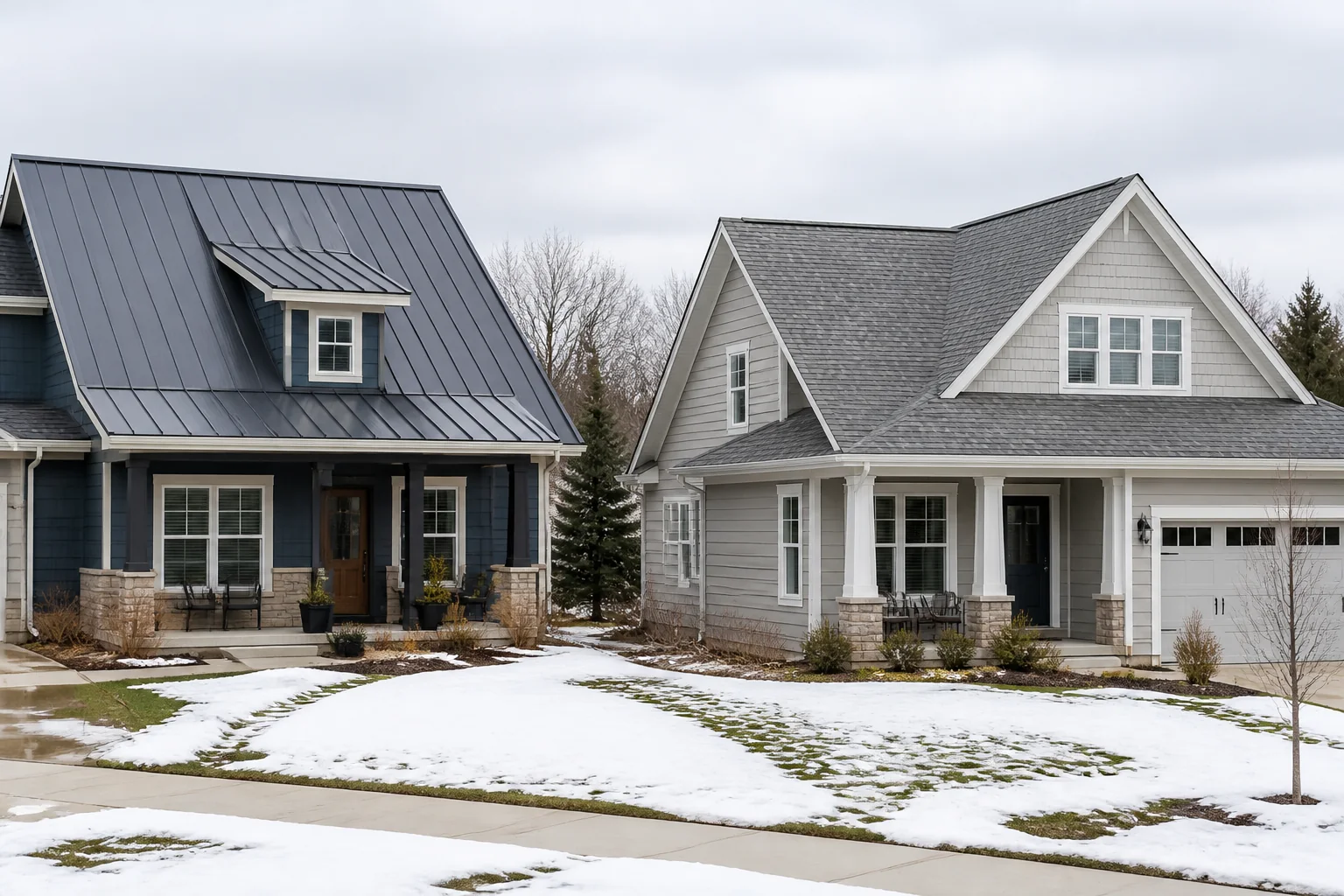
Quick answer: For a steep-slope home, start by comparing architectural asphalt shingles and a properly specified metal system. For a low-slope residential or commercial roof, compare membrane or modified-bitumen assemblies designed for that slope. Then evaluate the roof deck, drainage, insulation, installation details, maintenance, and written warranty together.
Start with roof slope, condition, and building use
A material that works well on one roof can be a poor choice on another. Before comparing brands, have the roof measured and inspected. Ask the contractor to identify the pitch of each section, existing roof layers, deck condition, signs of trapped moisture, and the route water takes to gutters, drains, or scuppers. A house can need more than one material: shingles on the main roof and a membrane over a low-slope porch, for example.
Do not assume that every metal panel is suitable for a nearly flat roof or that extra underlayment makes shingles appropriate at any pitch. Minimum slope, attachment, underlayment, and flashing requirements come from the selected system’s current instructions and applicable code. The transition between two materials deserves its own detail in the proposal.
Also describe how you use the building. A conditioned home, an unheated storage building, and a restaurant with roof exhaust create different demands. For commercial projects, discuss equipment access, tenant hours, odor sensitivity, roof penetrations, and plans for solar or new HVAC equipment. If the existing roof has isolated damage, read our Wisconsin roof repair versus replacement guide before assuming a complete replacement is necessary.
Roofing material comparison for Wisconsin properties
| Material | Typical application | Why consider it? | What to examine closely |
|---|---|---|---|
| Architectural asphalt shingles | Steep-slope homes and some commercial buildings | Familiar appearance, broad product choice, practical repair options | Actual impact rating, fastening, ventilation, flashing, and low-slope limitations |
| Standing-seam metal | Homes, agricultural buildings, and commercial roofs with a suitable system | Concealed attachment options and a distinctive, durable roof surface | Panel profile, expansion details, snow retention, coatings, and installation expertise |
| EPDM | Low-slope residential and commercial roofs | Flexible synthetic-rubber membrane with multiple assembly options | Seams, flashings, attachment, traffic protection, and chemical compatibility |
| TPO | Low-slope commercial roofs and suitable residential sections | Heat-welded seams and reflective options | Weld quality, membrane specification, cover board, and whole-building energy needs |
| PVC | Low-slope roofs, including applications with specific chemical exposures | Heat-welded seams and product-specific chemical resistance | Written compatibility with exhaust or grease, separation layers, and detailing |
| Modified bitumen | Low-slope roofs and smaller roof sections | Multi-layer assembly options, including self-adhered systems | Specified layers, substrate preparation, installation temperature, and flashing |
Residential roofing: asphalt shingles and metal
Architectural asphalt shingles: a practical starting point
Architectural shingles are worth comparing when you want a traditional roof appearance and a broad selection of colors and profiles. They can be a practical choice for homeowners who need to balance upfront cost, neighborhood appearance, and future repairs. Ask for the exact product name rather than a proposal that simply says “architectural shingles.” Different products within the same brand can carry different ratings and warranty terms.
For a manufacturer example, review GAF Timberline HDZ shingles. Use the product documentation to discuss the complete installation, including starter strips, ridge components, ventilation, and fastening. This is an example for comparison, not a statement that every product in the guide is stocked or installed by Riley’s Roofing.
In hail-exposed locations, compare tested impact-resistant products separately from ordinary architectural shingles. The Insurance Institute for Business & Home Safety’s shingle performance ratings provide an independent way to examine differences among tested products. An impact classification does not make a roof hailproof, and a warranty is not a guarantee that storm damage will be covered. Ask your insurer about any available discount and the documentation it requires before making a purchase decision.
Standing-seam metal: compare the system, not just the metal
Metal roofing is a strong candidate when you value its appearance and intend to own the property long enough to weigh the initial investment against ongoing maintenance. But “metal roof” is a broad description. Standing-seam systems and exposed-fastener panels have different attachment and maintenance considerations. Panel shape, seam design, finish, fasteners, clips, and accessories all belong in the discussion.
McElroy Metal’s standing-seam system information illustrates why profiles and applications need to be matched carefully. Ask how the selected system accommodates thermal movement and how valleys, chimneys, skylights, and wall intersections will be flashed. Confirm the approved roof slope for that exact panel.
Wisconsin owners should also discuss where sliding snow could land. Entrances, sidewalks, decks, parking areas, and lower roofs may need an engineered snow-retention plan. Do not assume a smooth metal surface removes the need to evaluate snow loads. For a closer comparison of these two residential options, see metal roofing versus asphalt shingles in Wisconsin.
Explore Riley’s asphalt roofing services in Wisconsin and Wisconsin metal roofing services when comparing project options.
What about slate, tile, cedar, or synthetic roofing?
Specialty materials can make sense when architectural character is the main priority, but they require a separate evaluation. Confirm structural capacity before substituting a substantially heavier covering. Ask about fire classification, moisture management, repair expertise, replacement-piece availability, and compatibility with the building’s details. Synthetic products vary considerably; compare the specific tested product and warranty rather than treating “synthetic” as one performance category.
Commercial and low-slope roofing: EPDM, TPO, PVC, and modified bitumen
A commercial roof should be specified as a complete assembly. The membrane is only the outer surface. Deck attachment, air and vapor control, insulation, cover board, perimeter edges, drainage, and flashings determine how that surface performs. A small residential low-slope section needs the same attention to compatibility, even though the project is smaller.
EPDM: a flexible rubber membrane
EPDM is a synthetic-rubber option for low-slope roofs. Carlisle’s EPDM product information shows different membrane and attachment choices, including adhered and mechanically fastened systems. Compare the exact membrane, reinforcement, seam treatment, and attachment method proposed for your building.
Ask how pipe penetrations and perimeter terminations will be handled and how service technicians will reach equipment without damaging the membrane. Dark and light-colored options should be considered in the context of insulation, building use, and heating and cooling demand. Color alone is not an energy plan, and a roof membrane should never be relied on to manage an unsafe snow load.
TPO: a thermoplastic membrane with welded seams
TPO systems use heat-welded seams and are commonly considered for low-slope projects. Review Carlisle’s TPO roofing options as one manufacturer reference. When comparing proposals, look beyond the abbreviation: membrane thickness, reinforcement, attachment, insulation, and cover board should be clearly identified.
Installation quality matters around drains, curbs, corners, and penetrations. Ask how the contractor verifies seam quality and protects completed work from other trades. A reflective surface may help reduce summer heat gain, but Wisconsin’s heating season means you should evaluate annual performance rather than assume a white roof guarantees lower utility bills.
For local service information, see EPDM roofing in Wisconsin and TPO roofing in Wisconsin.
PVC: evaluate exposure and compatibility
PVC is another heat-welded low-slope option. It may be worth evaluating where the roof is exposed to certain chemicals or restaurant exhaust, but compatibility must be checked against the actual substance and the manufacturer’s documentation. Carlisle’s PVC membrane information is a starting point for that conversation.
Ask for written confirmation of the proposed system’s suitability around exhaust outlets, existing roof materials, and insulation. Include any required separation layers and protection around equipment. The best choice for a retail office is not automatically the best choice for a building with grease exhaust or a demanding industrial process.
Modified bitumen: specify every layer
Modified-bitumen systems use asphalt-based roofing sheets in specified assemblies. Self-adhered options are available; CertainTeed Flintlastic SA provides examples for residential and commercial low-slope applications. The manufacturer’s published systems distinguish base, intermediate, and cap layers and show how warranty eligibility depends on the assembly.
A quote should identify the full system, not simply “rolled roofing.” Ask about substrate preparation, temperature restrictions, storage, application method, and the connection to adjacent shingles or metal. Do not confuse a finished low-slope roof system with an underlayment intended to sit beneath a different roof covering.
What Wisconsin weather changes about the decision
Ice dams require attention below the roof covering
Ice dams can form when heat escaping from a building melts roof snow and that water refreezes at colder roof edges. Replacing the covering without addressing the heat and moisture conditions may leave the underlying problem in place. The University of Minnesota Extension’s ice-dam guidance explains the role of heat loss and building conditions in cold climates.
For a Wisconsin home, ask about attic air sealing, insulation, ventilation appropriate to the assembly, and ice-barrier detailing. These are related decisions, not interchangeable fixes. Our Wisconsin ice-dam prevention guide helps you prepare questions for an inspection.
Snow, drainage, and freeze-thaw conditions
On low-slope roofs, discuss how water will reach drains and what happens if a drain becomes blocked. Ponding, deteriorated decking, or recurring leaks should be investigated before selecting a new covering. Ask whether tapered insulation or revised drainage details are needed. Snow drifting around taller walls and rooftop equipment can create localized loads that require professional evaluation.
For steep-slope roofs, review valleys, roof-to-wall intersections, and gutter discharge. For either roof type, do not climb onto an icy roof to diagnose a problem. An inspection should address both the visible symptom and its source. If you already have an active leak, start with Wisconsin roof repair rather than waiting to complete a material comparison.
Wind and hail: ask for assembly-level performance
Wind resistance is not just a label on the covering. Roof edges, fasteners, deck condition, and installation details matter. On commercial projects, request the applicable tested assembly and attachment design. On homes, compare product ratings together with the required installation conditions. No covering eliminates the need to inspect after significant storms.
If the project follows a storm, document damage before work begins and keep inspection findings separate from assumptions about coverage. Riley’s Wisconsin storm-damage roofing page explains the service, and the storm inspection and insurance checklist can help organize your records.
Reflectivity and installation season
ENERGY STAR’s cool-roof guidance explains that reflective roofs generally provide their strongest energy benefits in hot, sunny climates, especially on less-insulated buildings. For Wisconsin, compare reflectivity with insulation levels and year-round energy demand. Avoid a proposal that promises a specific utility saving without a building-specific basis.
Cold-weather work also requires planning. Ask how the installer follows the selected manufacturer’s requirements for surface conditions, adhesives, sealants, shingle sealing, and material storage. A calendar date alone does not determine whether an installation is suitable; actual conditions and the specified system do.
Compare total project cost, maintenance, and warranties
A useful price comparison includes more than the visible material. Request itemized treatment of tear-off, disposal, deck repairs, insulation, ventilation, flashing, drainage, permits, and site protection. For commercial buildings, include access arrangements and coordination around business operations. Two totals can differ because one proposal solves underlying problems while the other excludes them.
Ask what happens if damaged decking or wet insulation is uncovered. A written unit price or change-order process is more useful than a vague allowance. Also compare expected inspection and maintenance tasks, repair access, and the availability of compatible replacement materials. A lower upfront quote may be reasonable, but only when you understand what it includes.
Read both the manufacturer’s material or system warranty and the contractor’s workmanship coverage. Ask about exclusions, registration, transferability, required maintenance, and whether labor is included. A long warranty term is not the same as a promised service life. There is no single lifespan or installed price that reliably describes every Wisconsin roof.
Questions to ask before choosing a Wisconsin roofing contractor
- What are the measured slopes and which exact systems are suitable for each section?
- What did the inspection reveal about decking, moisture, drainage, and existing layers?
- Which product, attachment method, flashings, insulation, and accessories are included?
- How will ice-dam conditions, snow movement, and roof penetrations be addressed?
- Who handles permits, inspections, and any required design or plan review?
- What maintenance and warranty obligations will I receive in writing?
- How are unexpected repairs priced and approved?
Requirements depend on the building and project scope. Check with the local building department before work begins. For commercial projects, the Wisconsin Department of Safety and Professional Services commercial-building program is an official starting point for code and plan-review information. Do not apply residential assumptions to a commercial building or assume that every replacement has identical permit requirements.
Frequently asked questions
What is the best roofing material for a Wisconsin home?
There is no universal winner. Architectural shingles and properly specified metal systems are common starting points for steep-slope homes. The best choice depends on pitch, deck condition, appearance, budget, maintenance expectations, and the full installation. Low-slope sections may require a different system.
Is metal always better than shingles for snow?
No. Snow can slide from metal and create hazards below, while every roof still needs suitable structural capacity and detailing. Compare snow retention, entrances, lower roofs, and the underlying assembly instead of choosing solely on how quickly snow might shed.
Can a flat residential roof use a commercial membrane?
A suitable low-slope membrane can be considered for residential roof sections. Its specification must match the deck, drainage, adjoining materials, and local requirements. The building’s residential label does not make shingles suitable for a slope outside their approved use.
Should I choose EPDM, TPO, or PVC for a Wisconsin business?
Compare complete proposals for the building’s conditions. Drainage, insulation, equipment traffic, exhaust exposure, attachment, maintenance, and installer experience matter alongside membrane type. Ask the contractor to explain why the proposed assembly fits your property.
Will impact-resistant shingles lower my insurance premium?
Possibly, but it depends on your insurer, policy, location, and chosen product. Get any discount requirements directly from your insurer before purchasing. Impact resistance does not guarantee claim coverage or prevent every kind of storm damage.
Get a roofing-material recommendation for your property
Start with an inspection and a clear scope. Riley’s Roofing is based in Monroe; visit our Monroe roofing page and Wisconsin service-area guide for local information. If you are planning a replacement, our Wisconsin roof replacement page explains the next step.
Contact Riley’s Roofing with your property location, roof type, current concerns, and project goals. For a commercial or specialty system, confirm project fit and product availability before relying on a particular material recommendation. The manufacturer links in this guide are educational examples, not claims of brand certification or endorsement.