Wisconsin homeowners comparing metal roofing with asphalt shingles often hear absolute claims: metal lasts forever, shingles are always cheaper, metal sheds all snow, or hail ruins one material but not the other. Real performance is more nuanced. Product quality, roof geometry, deck condition, underlayment, flashing, ventilation, fasteners, and installation often matter as much as the surface material.
Both systems can protect a Wisconsin home. The better choice depends on how long you expect to own the property, the architecture, budget, tolerance for maintenance, storm exposure, snow behavior, and whether the contractor is experienced with the selected assembly.
The short answer
Choose neither material from a sample board alone.
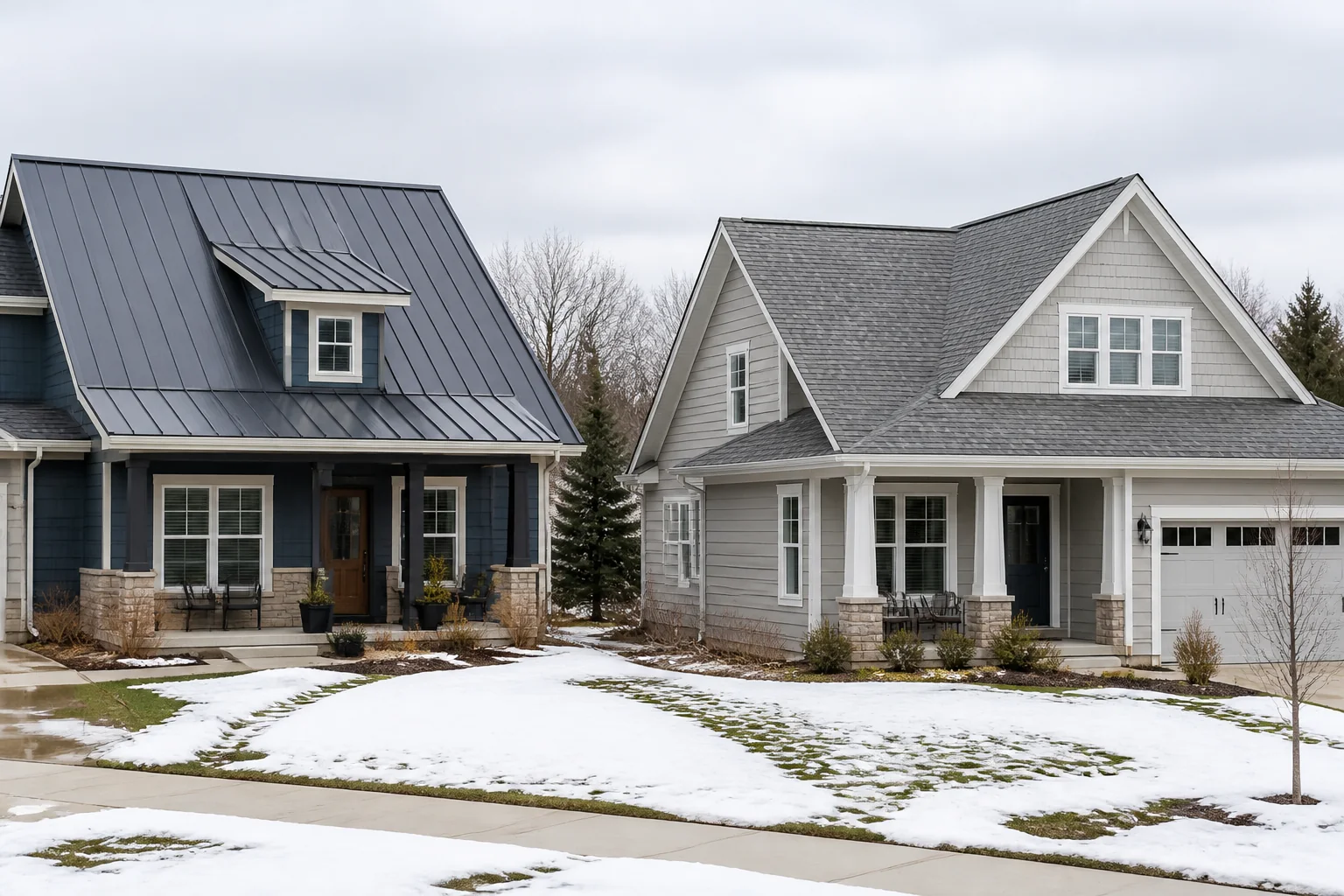
Asphalt shingles usually offer the lowest initial cost, familiar appearance, straightforward localized repair, and many colors and profiles. Quality architectural shingles are a practical choice for a large share of Wisconsin homes.
Metal roofing usually costs more initially but can offer longer service life, low routine maintenance, excellent snow shedding, and a distinctive appearance. Its benefits depend on correct panel, coating, flashing, clip or fastener design, and thermal-movement details.
The roof is a system. A premium panel over poor decking and flawed flashing is not a premium roof. A well-installed shingle system can outperform a poorly executed metal installation.
Wisconsin climate factors that matter
Snow load and sliding snow
Metal’s smooth surface can release snow more readily, especially on steep slopes. That reduces long-term accumulation in some conditions, but sliding snow can endanger people, gutters, lower roofs, landscaping, and equipment. Snow guards may be needed to manage release above entrances and walkways.
Asphalt’s textured surface tends to hold snow longer. That is not automatically harmful—the structure is designed for applicable loads—but prolonged snow cover can feed ice dams if the roof deck is warmed by attic heat. Snow behavior should be planned around roof slope, entrances, valleys, lower roofs, and attic performance.
Neither material eliminates the need to control heat loss. Ice dams begin with uneven roof temperatures. Air sealing, insulation continuity, and ventilation remain important with shingles and metal.
Freeze-thaw cycles
Water expands when it freezes. Repeated cycles exploit loose flashing, open seams, exposed fasteners, and damaged edges. Asphalt shingles need proper sealing and fastening; metal needs correctly designed laps, closures, sealants, clips, and penetrations that accommodate movement.
Metal expands and contracts with temperature changes. Standing-seam systems commonly manage movement with concealed clips or slotted details. Exposed-fastener panels require correct washer compression and periodic inspection because fasteners and seals are part of the weather barrier.
Hail
No roof is hail-proof. Asphalt can lose granules or suffer mat fracture. Metal may dent, and severe impacts can affect seams or coatings. Damage depends on hail size, hardness, wind, slope, substrate, product, and age.
Ask what the material warranty says about hail and whether cosmetic denting is covered. Also review the homeowners policy for cosmetic-damage exclusions. A roof may remain watertight while appearance changes, and coverage does not automatically follow performance.
Wind
Wind performance depends on tested assembly and installation. Asphalt shingles rely on correct nail location, count, deck attachment, and seal strips. Metal relies on panel profile, clips or fasteners, edge details, and secure transitions. Roof edges and corners experience particularly high pressures.
Do not compare package-level wind claims without confirming slope, deck, underlayment, fastening pattern, and installation requirements. Manufacturer instructions and current code control the actual assembly.
Asphalt shingles: strengths and tradeoffs
Advantages
Lower initial investment. Asphalt generally has a lower installed entry cost than quality standing-seam metal. This can leave room in the budget for deck repair, ventilation, gutters, or insulation work that materially improves the system.
Familiar appearance. Architectural shingles fit many Wisconsin homes and neighborhoods. Color blends can mimic dimensional wood or slate effects without the weight and cost of those materials.
Repair familiarity. Many contractors work with shingles, and a localized damaged section can often be integrated when the surrounding material remains flexible and a compatible product is available.
Sound characteristics. Over solid decking and underlayment, rain and hail noise is familiar and typically well controlled.
Tradeoffs
Shingles are a shorter-life covering than many quality metal systems, although actual life varies widely. Granule loss, UV exposure, heat, foot traffic, storms, moss, and ventilation problems affect aging.
They can become brittle, making later repairs harder. Wind can crease or remove poorly sealed tabs. Repeated ice dams can drive water beneath the surface if eave protection and attic conditions are inadequate.
Product category matters. A basic three-tab shingle, architectural laminate, and impact-rated premium shingle are not interchangeable. Compare test standards, warranty terms, weight, wind installation, and local track record.
Metal roofing: strengths and tradeoffs
Advantages
Potentially long service life. A properly designed and maintained metal system can provide decades of service. Coating, metal type, corrosion environment, seams, fasteners, and workmanship determine whether that potential is achieved.
Snow shedding. Metal can release snow efficiently, useful on some roof shapes when snow guards and drainage are planned.
Low routine material maintenance. Metal does not lose granules and is resistant to many forms of biological growth. It still requires inspections at penetrations, sealants, flashings, fasteners, and areas where dissimilar metals or debris can cause corrosion.
Appearance. Standing seam creates clean lines and suits modern, farmhouse, and traditional designs. Many colors and profiles are available.
Tradeoffs
Higher initial cost. Quality materials, specialized labor, trim fabrication, snow management, and detailed flashing increase the initial investment.
Installer dependence. Metal transitions are less forgiving of improvisation. Valleys, chimneys, sidewalls, end walls, penetrations, and panel terminations require system-specific details.
Denting and cosmetic expectations. Hail or foot traffic can leave visible marks. Some owners accept this as patina; others do not. Product and insurance cosmetic-damage terms should be reviewed before purchase.
Repair complexity. Replacing one standing-seam panel may require disassembling adjacent locked panels or trim. Future penetrations for solar, vents, or additions need compatible attachment methods.
Standing seam vs. exposed-fastener metal
“Metal roof” describes multiple systems.
Standing-seam roofing usually conceals clips and fasteners beneath raised seams. It can accommodate thermal movement and provides a clean appearance. Details and panel engineering vary, so the name alone does not prove quality.
Exposed-fastener panels attach through the panel surface with gasketed screws. They can be economical and effective for appropriate buildings, but fasteners and washers remain exposed to weather and movement. They require correct placement and periodic inspection. Using agricultural panels on a residence without residential-grade detailing can create problems at transitions and penetrations.
Ask the contractor to identify the exact panel, metal thickness, coating, seam, fastening system, warranty, and trim details.
Energy performance: avoid oversimplified claims
Roof color and surface properties affect solar heat gain, but Wisconsin has both cooling and heating seasons. The U.S. Department of Energy notes that reflective roofs can reduce summer cooling loads while creating a heating penalty in cold climates. Savings depend on insulation, attic design, roof color, HVAC efficiency, and building use.
Metal is not automatically a “cool roof,” and asphalt is not automatically inefficient. Painted metal can have tested reflectance and emittance values; reflective shingle products also exist. Bare shiny metal can have low thermal emittance. For most homeowners, attic air sealing and insulation may have a larger comfort effect than changing roof material solely for energy savings.
Request product data rather than relying on color names or broad claims about utility bills.
Comparing cost fairly
An accurate comparison uses equivalent scopes. One proposal may include full tear-off, deck repair allowance, new flashing, ventilation, snow guards, and premium underlayment while another omits them.
Compare:
- Tear-off versus installation over existing material
- Deck inspection and replacement rates
- Eave and valley membrane
- Underlayment type
- Flashing replacement
- Ventilation changes
- Panel or shingle manufacturer and line
- Fasteners, clips, and trim
- Snow-retention details
- Property protection and cleanup
- Workmanship and product warranties
- Future inspection or maintenance requirements
Calculate expected cost per year, but use conservative life assumptions. Include likely maintenance and the possibility that you will sell before realizing the full lifespan. Metal may offer excellent long-term value while shingles may be the better use of capital for a shorter ownership horizon.
Can metal be installed over shingles?
Sometimes, but “can” is not the same as “should.” Existing layers can conceal decking damage, complicate flashing, create an uneven substrate, and affect condensation or ventilation planning. Local code, manufacturer requirements, weight, roof geometry, and the condition of the existing assembly matter.
A tear-off allows direct deck inspection and clean integration of eave, valley, wall, and penetration details. If an overlay is proposed, ask how the contractor assessed the hidden deck, how the new system is separated from the old surface, and how flashing will be rebuilt.
Questions to ask any roofing contractor
- Which exact product and system are you proposing?
- Why does it fit this roof shape and attic assembly?
- What is the tested wind and impact classification?
- How will valleys, walls, chimneys, and penetrations be detailed?
- How will snow be managed above entrances and lower roofs?
- What happens if damaged decking is found?
- Which warranty exclusions involve hail, cosmetics, coastal exposure, or maintenance?
- Who performs the work, and what similar Wisconsin installations can you show?
- How are attic ventilation and ice-dam risks addressed?
- What inspections or maintenance will the roof need?
A practical decision matrix
Asphalt often fits homeowners prioritizing a lower initial investment, traditional appearance, readily available repairs, and a solid service life without planning to own the home for several decades.
Metal often fits homeowners prioritizing long-term ownership, low routine maintenance, snow-shedding performance, distinctive appearance, and willingness to invest more initially in a specialized installation.
Choose based on the entire roof and building. A house with moisture-damaged decking needs that corrected regardless of surface. A complicated roof with many transitions demands an installer skilled in the selected system. A simple steep roof may be an excellent metal candidate, while a well-ventilated conventional roof may receive outstanding value from architectural shingles.
Riley’s Roofing installs asphalt roofing in Wisconsin and metal roofing. A useful estimate should explain why the recommended assembly fits the home—not merely which product carries the largest price tag.
Sources and review information
- Wisconsin DSPS: Uniform Dwelling Code
- U.S. Department of Energy: Cool Roof Guidance
- National Weather Service: Severe Thunderstorm Safety
- ReadyWisconsin: Winter Storms
This guide was prepared for Wisconsin homeowners and reviewed for Riley’s Roofing, a licensed and insured contractor based in Monroe, Wisconsin (WI contractor license 4742-DCFR). Product availability, warranties, code, and roof conditions vary; obtain an on-site assessment and written specifications.