A ceiling stain creates an urgent question: can the roof be repaired, or is it time to replace it? The honest answer cannot be determined from the stain alone. A failed pipe boot on an otherwise healthy roof is a repair. Repeated leaks across a brittle, poorly ventilated roof may be evidence that more patching will only postpone the inevitable.
Wisconsin adds snow, ice dams, hail, wind, deep cold, and repeated freeze-thaw cycles to the decision. Those conditions expose weak flashing and aging materials, but they do not make every leak a replacement project. The goal is to identify the failure, measure the condition of the whole system, and compare the expected life and risk of each option.
Start with the cause—not the age
Roof age is useful context, not a diagnosis. Product type, installation, ventilation, sun exposure, tree cover, maintenance, and storm history can make two roofs of the same age perform very differently.
A professional inspection should identify the water-entry path or damaged component. Common repairable causes include:
- A cracked plumbing-vent boot
- Loose or corroded flashing
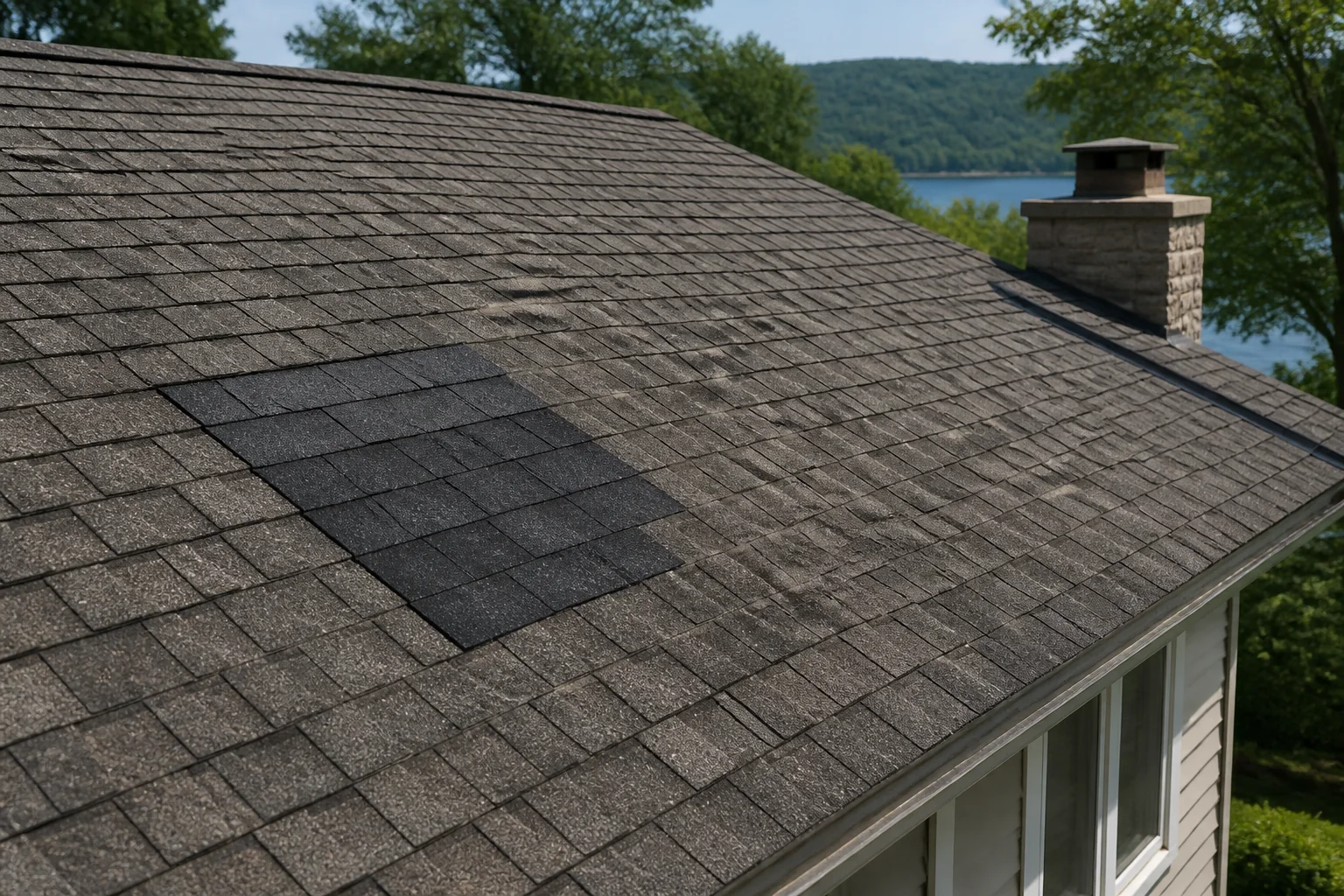
- A small area of wind-damaged shingles
- An exposed fastener
- Failed sealant at a metal transition
- Localized damage from a branch
- A gutter or downspout problem causing water to back up
Broader problems include widespread shingle cracking, repeated ice-dam leakage, numerous prior patches, failing underlayment, deteriorated decking, systemic fastening errors, or ventilation and moisture problems affecting multiple areas.
Water often travels before becoming visible. The stain may be downhill from the entry point, and condensation can imitate a roof leak. The attic should be checked for wet insulation, frost, mold-like growth, plumbing or mechanical moisture, and staining patterns on the decking.
Seven factors that determine the right scope
1. Is the problem isolated?
A repair is most defensible when damage is confined to a clearly identified area and the surrounding roof remains flexible and serviceable. If leaks occur on several slopes or after different weather events, the roof may have multiple failure points.
Ask the inspector to show overview photographs, not only close-ups. A tight image proves a defect exists; a wide image shows whether it is isolated.
2. Can new material integrate with the old roof?
Shingles become less flexible with age. Lifting them to install flashing or weave in replacement shingles can crack adjacent material. A repair that requires disturbing a large brittle area may create more risk than it removes.
Color matching is another consideration, but performance comes first. Discontinued profiles, dimensions, or fastening patterns can make a technically sound repair difficult even when a visually similar color exists.
3. What condition is the decking in?
Decking supports the roof covering and fasteners. Chronic leaks, attic condensation, or repeated ice dams can soften, delaminate, or rot wood. Surface materials may hide the extent of damage until shingles are removed.
A small deck repair can be included in localized work. Widespread deterioration points toward replacement and may require an allowance because the exact quantity is not visible in advance.
4. Are flashing and penetrations reliable?
Many leaks occur at chimneys, skylights, walls, valleys, vents, and roof transitions—not in the open shingle field. Replacing shingles without rebuilding defective flashing can preserve the leak beneath a new surface.
Conversely, rebuilding one flashing assembly can solve a leak on a roof that otherwise has years of life. The proposal should name the detail being corrected rather than promise vaguely to “seal the area.”
5. Is attic heat or moisture damaging the system?
Uneven snowmelt, frost on nails, wet insulation, and recurring ice dams suggest that the building below the shingles needs attention. Air leakage, poor insulation continuity, blocked soffit intake, or improper exhaust can shorten roof life and create leaks that no surface patch will permanently solve.
Before replacement, identify improvements that should occur while the roof is open. Otherwise, the same conditions can affect the new materials. Our Wisconsin ice-dam guide explains this relationship in detail.
6. Was there a recent covered storm?
Sudden wind, hail, or impact damage is evaluated differently from wear. Document the event and contact the insurer when appropriate. Coverage, deductibles, roof-payment schedules, and exclusions vary. A contractor documents construction conditions; the carrier decides coverage.
Do not replace storm evidence before it is documented unless emergency work is necessary to protect the home. See the Wisconsin storm-damage checklist for a safe sequence.
7. How long do you need the solution to last?
A repair may be rational when it restores a healthy roof and is expected to last with the surrounding system. It may also serve as a temporary measure when replacement is planned but weather or budgeting requires time.
Be explicit about which one you are buying. A temporary repair should not be priced or described as a permanent solution. If you expect to own the home for many years, repeated service calls, interior risk, and future material inflation belong in the comparison.
Signs that repair is likely reasonable
Repair often makes sense when:
- The roof is generally in good condition.
- There is one confirmed failure point.
- Damage affects a small area.
- Matching, compatible material is available.
- Surrounding shingles can be manipulated safely.
- Decking and flashing outside the repair are sound.
- There is no pattern of recurring leaks.
- The repair does not invalidate a material warranty.
Examples include replacing a failed vent boot, rebuilding localized wall flashing, correcting a small wind-damaged section, or repairing a puncture after removing a branch.
Signs that replacement deserves serious consideration
Replacement becomes more reasonable when:
- Leaks recur in different places.
- Shingles are widely cracked, curled, loose, or brittle.
- Granule loss is extensive and exposes asphalt.
- Numerous repairs already exist.
- Decking deterioration is widespread.
- Flashing details are systematically incorrect.
- The roof has widespread storm damage.
- Materials needed for a reliable repair are unavailable.
- A second roofing layer complicates integration or inspection.
- The remaining service life is short relative to the repair cost.
No single bullet proves replacement is required. The decision comes from the combined condition and the ability to create a watertight, maintainable system.
Why “cost per year” is more useful than the lowest bid
Suppose a repair costs less today but is likely to be followed by replacement soon. The homeowner may pay for mobilization, disposal, flashing work, interior risk, and landscaping protection twice. Conversely, replacing a healthy roof because one boot failed wastes usable service life.
Compare scenarios:
- Targeted repair: scope, warranty, expected remaining roof life, and known limitations.
- Broader repair: whether adjacent flashing, shingles, or decking must be included.
- Replacement: complete scope, ventilation or deck corrections, warranty, and expected service life.
Divide the total cost by realistic years of service, but do not pretend the forecast is exact. Include the consequence of failure. A leak above an unfinished garage does not carry the same interior risk as one above a finished kitchen or electrical equipment.
Avoid relying on universal online price averages. Roof area, pitch, height, access, layers, decking, flashing, ventilation, material, permit requirements, and disposal all affect a Wisconsin project. A written inspection and measured proposal are more useful than a national calculator.
What a complete replacement proposal should specify
A strong proposal identifies:
- Tear-off and disposal scope
- Deck inspection and replacement pricing
- Underlayment and ice-dam protection
- Manufacturer and product line
- Fastening method
- Valleys, drip edge, and flashing details
- Pipe boots and other penetrations
- Intake and exhaust ventilation
- Chimney or skylight exclusions
- Property protection and cleanup
- Workmanship and manufacturer warranties
- Permit responsibility
- Payment schedule and change-order process
Wisconsin’s Uniform Dwelling Code applies statewide to qualifying one- and two-family dwellings, while local authorities handle enforcement and permits. Roofing details must also follow current manufacturer instructions. A low proposal that omits necessary components is not necessarily a lower-cost roof.
Repair mistakes that create repeat leaks
Temporary roof cement has legitimate emergency uses, but smearing sealant over a complex leak can trap water and obscure the actual defect. Face-nailing exposed shingle surfaces, layering incompatible materials, reusing damaged flashing, or fastening through a drainage path can convert one problem into several.
Another mistake is treating every winter leak as failed shingles. Ice dams and attic condensation require evaluation of insulation, air sealing, and ventilation. Likewise, staining around a bathroom may originate from an exhaust duct rather than the roof surface.
The repair should explain the mechanism: what failed, how water traveled, what will be removed, how the assembly will be rebuilt, and how success will be checked.
Questions to ask before signing
- What is the confirmed or most likely source?
- What evidence separates this defect from other possibilities?
- What surrounding materials must be disturbed?
- Is compatible material available?
- Is the repair permanent or temporary?
- What is excluded?
- What happens if hidden decking damage is found?
- How does the workmanship warranty apply?
- What remaining life do you expect from the unrepaired roof areas?
- Would you recommend the same scope if this were your home?
A contractor willing to discuss the limitations of both options is more useful than one who presents replacement as the answer to every leak.
Request the photographs and written findings for your records. They create a useful baseline for future maintenance, insurance questions, and resale disclosures even when the immediate recommendation is only a small repair.
Get an evidence-based recommendation
Riley’s Roofing provides roof repair in Wisconsin and complete roof replacement. The inspection should lead the recommendation: repair when a repair can reliably protect the home, and discuss replacement when the system no longer supports a durable patch.
Sources and review information
- Wisconsin DSPS: Uniform Dwelling Code
- Wisconsin OCI: Homeowners Insurance FAQ
- ReadyWisconsin: Winter Storms
This guide was prepared for Wisconsin homeowners and reviewed for Riley’s Roofing, a licensed and insured contractor based in Monroe, Wisconsin (WI contractor license 4742-DCFR). It is general information. An on-site inspection, current code, manufacturer instructions, and policy language control each project.